
Joy In Act III: An Interview with Kathryn Grody

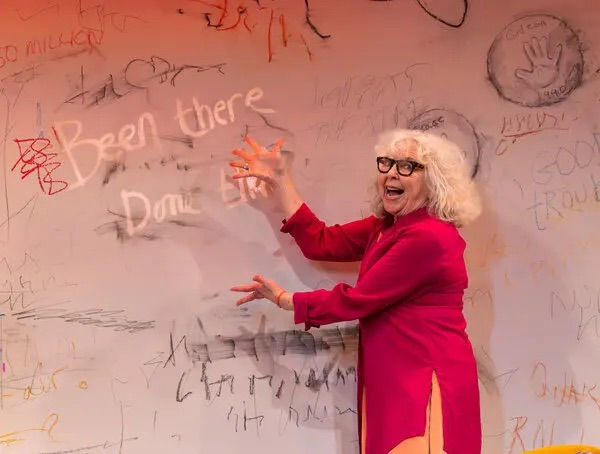
If you’ve seen Kathryn Grody’s show The Unexpected Third, the Tik Toks, or Don’t Listen To Us, the podcast she does with her husband Mandy Patinkin and son Gideon, you will be delighted to know that speaking to her one on one is exactly as marvelous as you’d hope. Grody is refreshingly candid, completely lacking in pretension, well read, even better informed, and very, very funny. An accomplished Drama Desk Award nominated actress on stage and screen her solo show The Unexpected Third is currently running through June 14th at NY Theatre Workshop’s In the Bricks Series.
Wendy-Lane Bailey: I am so excited that I get to talk to you! I loved The Unexpected Third, and, like many people, I've been invested in your TikToks for quite a while. .
Kathryn Grody: That's a whole new odd world that we didn't expect. The upside of the
downside of the heinous technology, you know? It's what we're in control of
instead of it being in control of us.
WLB: This is not your first solo show. What is it about solo performance that attracts you to the medium?
KG: It's really simple. I've done three solo shows. They've all been about topics that I thought a lot of people were experiencing but was not being discussed in the zeitgeist. I also like
working. And you know, as I say in the show Estelle Parsons said “If you want to work after 50, be prepared to be mothers of men you're 20 years younger than.” I just was so pissed off. And I had things to say that I thought other people might want to hear, identify with.
I've been working with the director on The Unexpected Third, Timothy Near. We met in college. She was a few years ahead of me. She was the glorious star that I was intimidated by.
I first had this idea of A Mom’s Life [her first solo show], when someone asked me after I had my son Gideon in 1986, they literally said, “oh, are you working now?” I couldn't believe it. I really couldn't believe it. And this is one of my favorite theater stories, Wendy-Lane, and it has
anchored me every single time when I have felt theatrically invisible. I went to Joseph Papp and Gail Merrifield Papp, and said, “I have this idea. I wanna answer that question theatrically." And Joseph Papp said, "If you write it, I'll produce it." I'd never written anything other than letters. I said, "Joe, I need a place to write. I can't write at home.” He gave me a desk and a Selectrix typewriter at the Public Theater when Gideon was one year old. I did it all over the place for 10 years.
My second one was a little bit of a sort of familial disaster. I did a piece called, Falling Apart Together. I was very unnerved by all these people that seemed to be getting married every two years. I wanted to show how a dynamic in a family or in a relationship can start out phenomenally and go through catastrophe, but you can sometimes work through those catastrophes and enfold that into your larger story. I played both my sons, I played my husband and I played all these characters. It was probably my best acting work ever, but both my husband and eldest sons had heart attacks. They were both in places that I didn't realize that made my portrayal of them difficult. Even though my son was 30, he was not comfortable with that vision of him at 18. I don't think he felt far enough away from it. My husband, had seen a version of it a year before and loved it, but a year later he was a different human being and felt differently. I ended up doing a workshop at the Public and four shows at Classic Stage, thanks to beloved Brian Kulik, and I had to put it away. It killed me, but that was one of those choices where am I going to cause harm to my family or put away the best thing I've done? It’s interesting, this piece that you saw, I don't have to worry about that, because it's just frigging me. I am not doing any of them, it's my story, and that makes it much easier.
WLB: This segues nicely into my next question because there are two things you say in the show which, as someone who’d been married a very long time, resonated strongly with me. One was, ”when I look at my mate, I see all the versions of him.” Then later you say, “we have weathered the brutalities of intimacy”. Both of those phrases are extremely evocative.
What effect does that ability to see all the various versions have on a relationship?
KG: I am so grateful for the history we have! Not all marriages should last 30 or 45 years. I'm the first to say that. But for us, it was what we both ended up needing. The connection we had was clearly so much bigger than what drove us nuts. And I really do see those versions of him. It's very weird. My husband now has a beard down to here that's white for two
projects that he's doing. And he looks quite a bit older with that beard, quite stunning, but you know. But I still see that guy walking into that restaurant, the baby, carrying these little button mums. And I know he sees those versions of me. So when I am feeling haggard or just unbearable, not how I want to be presented to the world, he always says that he sees all those versions of me. And I've decided to believe him whether that's real or not.
That line about weathering the brutalities of intimacy is really interesting to me.
During the pandemic, we did an interview with Sarah Lyle of the “New York Times”. As I was talking to her at the end of the interview, I said, “oh my God, Sarah, I hope you're recording this because I think I said something really profound, but I can't remember it.” She said, “oh yeah, I am.” The next day she called me. She said, “Catherine, I was using new recording equipment and it didn't work, but I take really good notes.” And I said, “oh shit.” I said, “it's okay, it's not your fault, Sarah. I just, I cannot remember what I said.” Well, that's what I said, to have weathered the brutalities of intimacy. It's a daring thing, it astonishes me. I can't believe I just came up with that in an extemporaneous conversation. I mean, it makes me very impressed with myself, which I can say right now because that doesn't happen very often these days.
I just went to see Leslie Ayvazian’s show (“Mention My Beauty”). It's so interesting... Before I saw the show, I congratulated Patricia McGregor (Artistic Director NY Theatre Workshop). I said, “boy, having two out of four shows by 79-year-old female playwrights, that's a radical act. I was just astonished when I saw Leslie’s show last night. We are the same age. We grew up in the same years. We lived on different planets, both emotionally, physically, politically. We were completely different humans at the same time. And I love it! I can't stand monoliths. I've never liked all two-year-olds, all teenagers, all women, all Jewish people, whatever the hell. I'm a big believer in our idiosyncratic individual natures. And I couldn't get over how different our stories are. We've known each other for 30 years casually and we played sisters in a PBS movie a hundred years ago with Uta Hagen as our mother. It was very affirming about how many different stories we all have.
WLB: We need that right now, I think. Having role models for every stage of life is important, especially for women. We receive so many mixed messages about what our lives should look like. How is your generation changing that conversation?
KG: When I started working on the show, three and a half fricking years ago, I did Berkeley Rep in October of 22. I wanted to get it up because I think it was Rick Rubin that said, if you have an idea, act on it, because most likely if it's a good idea, it's in the zeitgeist. And if you don't, somebody else will. I was like, I got to get this up, I can feel it. Because suddenly going from nothing, there's “Oldster” Substack, there's “70 over 70”, there's Julia Louis- Dreyfus. Suddenly we're in focus. I thought, oh, fuck, I was one of the first, and now by the time I get anybody to produce this, it's going to be old hat. But then I remembered my mother telling me years ago, there's not just one love story, and there's not just one of these stories. I feel I'm part of this sort of cosmic recognition that people of a certain generation may have something of value to share. I love it.
I do these talkbacks after the show. I'm going to do one of them tonight. I'm pretty nervous about doing it here, but they've been phenomenal in Pennsylvania and in California, because people want to talk. People want to share their experiences or ask about things. And it's multi-generational. That's one of the things that has just moved me so much and surprised me. I knew people over 50 would relate to a lot, but I have all these young people. This gorgeous girl comes up to me in Pennsylvania, says, “Kathryn, it's my 36th birthday today. And the gift you've given me is you've made growing older look exciting.” This other girl, Raya, talked about how she's 30 years old. She said, “my generation says if I don't have my person, my place, my profession, and my Botox account, by 35, my life's over. And your play says, that's bullshit.” Those kinds of things really move me and make me feel this is worth it.
WLB: You're very honest about a lot of things in your show.That endears us to you as an audience because none of us are perfect. You are particularly forthright about your feelings on our changing world.
KG: You know, this is for anybody. One of my favorite moments that I really enjoy is when I talk about the creepy skin and then I say, oh, thank God I don't have that. Lucky me, so exceptional. I love calling myself on that. And believe me, Wendy, my sons are very big on me if I at all feel like I'm, you know, something special. I know they were very concerned about me portraying a black South African young man and weren’t sure. I said, guys, I've asked Khalisa, He is thrilled to be in my show. He finds it hilarious that for one minute I am sharing this guy that I love. That's one of those constraints, you know, as an actor. I remember having fights with Mandy 100 years ago because he was gonna play a Puerto Rican cab driver in one scene in a movie. I said, you can't. And he's just beginning. I'm in my early thirties. He's 25. And he's so excited about getting this one little part. He said, why can't I play that? I said, because you can't take that part away from Puerto Rican actors. He said, I'm an actor. I wanna play anything. I wanna play women. I wanna play anything. Then we had a big thing years later about him maybe playing a deaf person. It's a very curious question as a theatrical person. You know, what those limitations are because the whole point was we could be so many more people than just the one person we are. The question is how do we give, how do we widen the soup of opportunity for everybody? I hope we continue to be complicated, convoluted, excited, idiosyncratic people as opposed to becoming one automated voice.
I have an argument with a very close 40 year old friend, Mikhail Suleiman, who's a big sound designer and writer. And he's very mad at me for being negative about AI. He says that what AI will never be able to capture, which will limit it, is human idiosyncrasy. Maybe, but I feel they are not so subtly training us to be comfortable with the flattening of human experience. All those voices, whether they're male or female, are flat. They are not human. They are not messy.
You know, there's a new book out on Friction Maxxing. This is hilarious. Friction Maxxing, from what I heard, is basically the way we used to live. Instead of going online to order something, go stand in a line. Go to the market, be with people that you don't know, practice being civil, practice not being impatient, practice slow human time. And it just made me laugh so much.
I am the lunatic woman of the Upper West Side. If I see a parent talking to their kid in a stroller, I say, “excuse me. I just want to tell you how beautiful it is to see you talking to your child instead of being on your phone. It's really important.” I have two fabulous sons, and I'm convinced a lot of it was because we shared life and the city together.
WLB: In the voice intro to your show you say you believe in joy and beauty as
Tools of resistance. How do you use these tools to combat the ugliness we see around us?
KG: I intend to be better at that than I actually am. I am a world class catastrophizer by nature. I came across a letter I'd written to my parents my freshman year of college about Vietnam. My poor parents, man. I couldn't believe my country was doing this. I'd been raised to think it was the best place. I took it personally. So It takes a real effort like exercise, like stretching, to see the beauty of a day. There is beauty every day, whether it's saying hello to a baby or a person you've never met in the elevator. Look for the look for the beauty. Look for the joy. You will find it.
Respair is a word from the 1500s, because clearly they had issues in the 1500s where they were hopeless. Rebecca Solnit talks about this a lot in her work. She has a great historical perspective where she is not in a panic about now.
I'm participating in elections and I am not discussing leaving this country. I'm not doing that. I'm not putting it in the atmosphere. I am working to elect people to the Senate. I'm working with states rights. I'm working with individual campaigns. And and I'm manifesting for whatever it's worth that we can get control and make a decent government again.
I listen to Jessica Craven. What I love about her is the good news of the week. She'll say, "Here's the 10 good things that happened." And if I didn't read her I wouldn't know that this court in this little town voted fairly to right or wrong. I feel embarrassed quoting myself in the play – “Despair is a choice”.
WLB: What do you think theater, particularly solo theater, since that's the genre where we're currently exploring, has to offer this conversation in this moment?
KG: Connection and conversation. Solo performing is an oddly intimate form, at least in the way I experience it. I really do feel like I'm talking to you in this show more than the other two. I've never done a show where I get vocal affirmation when I ask a question. You know, when I say, was it Rilke that said we have to hold beauty and terror in one hand? Oh, have I said that before? And at least 10 people go, yeah. They're my partner. So for me, It's like having a wonderfully intimate conversation with a bunch of new people that I've never met before.
Today is Alvin Epstein's birthday.I think he probably would have been 103 or something. his niece came to see the show last week, It was so moving to me because he was a model for me when I thought 80 was a hundred years away. It's a very strange thing, these numbers and how we all experience them differently and how they're looked on in the culture or how you're dismissed or made irrelevant or patronized or honored.
I think sometimes the obsession with the landscape of the body - I wonder, if we're focusing on this because we don't know what to do about what's out there. There's a generation that has been raised being told their planet is not going to last. We are not doing what we need to do for climate. Rachel Carson, 1963 said, stop poisoning, right? And then we have people in charge of the environment poisoning. Sometimes I think people just go, I can't deal with the outside. I feel powerless. This I can express myself. I can tattoo all my opinions and all my dreams. I can take care of this. I'm empathetic to that, though it's not my way of dealing with making this place better, but it's my way of trying to understand sometimes.
WLB: Towards the end of the play you talk about looking in the mirror and saying, “look how many people I got to be in a lifetime.” Which is such a wonderful way of looking at aging.
KG: I liked that line when I came up with it and I try to practice that. One of the things I hate about these Zooms is I get totally distracted about seeing myself. I'm like, oh my God, I didn't put on enough makeup. My lipstick is gone.I think that's human nature too. But oh my God, I wanna make that a little part of my day.
What makes a person beautiful? Curiosity. If you listen to somebody, if you make a connection with somebody, that's what makes you beautiful. That's why I say in that part of the play, please, people, look how young you are. Look how beautiful you are. Don't waste time. You are gonna look back.
There is a video that is just staggering. I'm 35 years old. Our son is six months old. Mandy and I are such lunatics. It looks like our son should be taken away from us. At one point, Mandy picks up a silver rattle and he goes, “this is a rattle that Daddy's agent gave him”. And you hear from me in the background going, “and Mommy's agent”. I don't even remember that person. At one point I'm going, “get that camera away from me. I look like shit today”. I was gorgeous. I never knew I was gorgeous. I always thought I was fine for a character actress. And I'm like, whoa, appreciate it, because I know how I am right now is gonna be different than if I'm lucky enough to live another 20 years. And I think I want to, if I have my mind, and if I'm able to carefor myself. Maybe if I've lost my mind and can't care for myself, I'll still be saying, no, never mind. Never mind, don't take me out. I'm happy for the moment, but I think practicing being in the moment that you're in is the basic Buddhist thing, but gosh, it's hard to do.It's not about being perfect. It's about making that effort.
WLB:Your show is an extremely physical show. Yeah. I mean, you are up, you're down. You're doing pushups, singing. How do you prepare for that?
KG: You know, it's funny. A lot of people say that. I very much appreciate it. I'm working very hard to be a fit person, but you know what, Wendy-Lane, I feel I move so much less inventively than I did in my other shows. That's that comparison leads to violence thing. If you compare yourself to somebody else, you want to do violence to them or violence to yourself. When people say, “oh my God, you're so physical”, there's a little voice goes, “oh, you should have seen me 20 years ago.” And then I just go, shut the fuck up.
I remember seeing two solo shows, Elaine Stritch, At Liberty, when I think she was 84. And in a little North Hollywood dump of a theater, Kitty Carlisle Hart. She was like 95.
She got out there in her sequined gown and stood up straight with a screen behind her with all these film clips. We went backstage to see her afterwards. She was in a wheelchair! And Elaine looked ageless out there with those legs. She loved to show off so much.Then you
go backstage and you go, whoa, are you the same person? It's amazing what adrenaline and the desire to share something does to you. I sometimes think, have I become Elaine and Kitty Carlisle Hart? Or is that- Not yet. Just me. Not yet, not yet.
I always tell Mandy too, if he compares his voice now to his voice then that “it's the way you act a song. It's the way you tell it, not just the pretty notes.”
People ask me how long I want to do this show. I don't know. I'd like to do it here. I'd like to do it in LA, Chicago, Boston. London is my big dream. A little place in Hampstead, And then if PBS still exists, maybe I'll film it and call it a day. You know, my director and I laughed a lot about, oh, now we're going to do the expected fourth, the two of us.
Oh my God, if you don't have.
humor about being in this body that is not meant to live forever, you're lost.
WLB: All of the shows in the series deal with serious issues, but they do so with a great deal of humor.
KG: What I love about Liza Jessie Peterson’s show [The Peculiar Patriot], and you
know, when you see the marketing line, it's about the inhumanity of the incarceration. She powerful shows the straight line between plantation and prison population doing all this free work for corporations. But what it's about is creative resilience. Oh my God, the language she uses, the humor, the love in impossible situations. It is such a testament to how phenomenal we can be under the worst circumstances. It's that Viktor Frankl, “Man’s Search for
Meaning” thing, even there, even in those camps, they don't own how you look at the heavens. You can have your experience with the stars wherever you are. I found it really remarkable that that woman's been doing it for 25 years. And she's retiring it. This is it. She's retiring this character.
WLB: We recognize that life is hard, but I feel like the message I take away from your show and all of the shows that I have seen at “In the Bricks” is that it's possible to, to turn your story into something wonderful. What solos performers have inspired you to tell your story?
KG: “The Lodge of Sun”, that was one of the best shows I've ever seen. Ryan Haddad, who I love. Alex Edelman. All the English. During the pandemic, I was watching that
documentary, “Dames at Sea”, with Judi Dench and Eileen Atkins and Maggie Smith. And my poor son, I'm sobbing at the end of it. And he's like, Mom. And I said, that's what I thought my life was going to be. I was going to be in regional theater and I was going to grow older and raise families with all my actor friends. It's just not the American model.
I love my husband's solo shows. I don't think anybody sings and acts a song like him. It's obnoxious to say that, I guess.
I recommend seeing anything by Geoff Sobelle. Put him on your horizon.
WLB: What would you say to aspiring solo performers ?
KG: Trust your gut. Trust your gut. Here's a good story for that. I love this story.
What I would say to those kids, is Mandy Patinkin, after doing Evita wanted to do songs with just his piano player. Every expert in the Broadway theater, every one of those producers said, that's not possible. No one will come see you. You have to have a 10-piece orchestra and maybe a few dancing people. The only person that said differently was Joe Papp. Joe Papp said, “you didn't ask me. Come try your idea. You're doing ‘Winter's Tale’ on Monday night. Sing, see if it works.” And that's how my husband supported this family for 37 years with him and Paul Ford and now Adam Ben David on a piano. He followed his gut and he listened to himself. So when all the experts tell you something can't be done, listen to your gut and don't listen to those
experts because you're right and they are wrong. That's what I would say to them.
And also I would say something else. Say yes, even if it's not what you expected, even if it's not what you planned. I was asked to go coach a young actor on Sardinia for three months in 1978 when I'd just gotten here by somebody I knew. I was like, coach a kid in Sardinia? I'm an actor. I'm in New York getting work. Well, guess what? What did I do for those three months? I waited on tables and had a couple of auditions. I could have coached Henry Thomas in “Black. Stallion”. I could have earned money. I really like working with people. And you know, who knows? I might've married Caleb Deschanel who was the cinematographer and my whole life would have been different. It worked out for me the way it was supposed to. But I say, just be aware if something falls in your lap that wasn't part of your plan, go with the yes. Go with the yes, go with the adventure, go with the unexpected. And I think we should still do that at any age. And that's why I like saying, I hope to be an unfinished 90. I would love it if people said, oh my God, she was 95. But you know what she was doing? She was finally learning Spanish.
See Kathryn Grody's The Unexpected Third at New York Theatre' Company's In The Bricks series running until June 14th


The selection appears suitable for different occasions, whether customers are purchasing everyday essentials giggles for littles or thoughtful gifts for young children. A well-maintained catalog and clear product presentation can make shopping more enjoyable and efficient.
Well-balanced perfumes combine freshness with lasting performance. Carefully selected notes create an appealing fragrance experience. Many collectors admire LV Imagination for its modern and refined character. A signature scent can leave a positive impression wherever worn.
Market changes often encourage consumers to seek updated information. Reviewing recent announcements mile high compounds can prevent misunderstandings. Searches related to amino asylum shut down remain common across health discussion forums.
A hijabs can completely transform an outfit with their elegant appearance and comfortable feel. Premium fabrics provide excellent draping and lasting quality for daily wear. They are suitable for both casual and formal occasions. A well-made hijab always adds confidence to personal style.
Financial education helps people make smarter decisions after receiving unexpected income. Estimating how to calculate taxes on $5000 lottery winnings deductions in advance reduces uncertainty during the claim process. Learning provides a clearer picture of the amount that may actually be received.