
Disco Balls, Game Shows & Southern Shade – An Interview with Are You Mad at Me’s Bryan Safi

Updated: Aug 16

Disco Balls, Game Shows & Southern Shade – An Interview with Are You Mad at Me’s Bryan Safi
You may not know it, but Bryan Safi has probably been in your living room. For several years Safi has been a regular presence on television screens through his recurring roles on Ryan Murphy’s 9-1-1, Damon Wayan’s Poppa’s House, and Netflix’s You and Young & Hungry. He is the co-host of two podcasts – Attitudes and Ask Ronna. If that weren’t enough, he has been nominated for two Emmy awards, won a Webby Award, two Podcast Awards, and made the list of Out Magazine's Out 100 LGBT+ people.
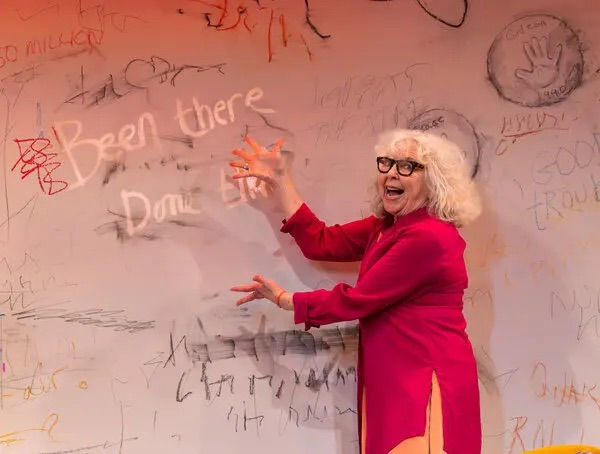
Now he has ventured into Solo Theatre with his new show Are You Mad at Me?, a hit at the Edinburgh Fringe which is now running at HERE Arts through August 15th. Written and performed by Safi, with Creative consultation by Kevin Zak, and Jennifer Love Hewitt as consulting producer, the show is a rowdy mix of stand-up, game show, and cabaret that features audience participation AND disco-balls. A delightfully funny show, he handles the very serious issues of homophobia, anxiety, and people pleasing with a deft touch.
I had a wonderful time sitting down with Bryan to discuss solo theatre and then some.
WLB: What brought you to Solo Theatre?
BS: I’ve worked in partnerships most of my career, whether it’s an ensemble in a Television show or two podcasts with partners on both. I’ve always been drawn to exploring a singular voice. To really be uncompromising with what you have to say and not have to run it by anybody else. It’s your point of view, it’s your opinion and it’s your perspective. Solo performance is completely inspiring in that way.
Growing up, my hero was Sandra Bernhard. It was the way she expressed herself. She did it in such a distinctive way without self deprecating. I self deprecate quite often in my show, but she never did. It was such an unusual thing, exuding that confidence and packing it with a punch. Also, watching other solo performers who I came up with in comedy like Drew Drogue’s Bright Colors & Bold Patterns. Certainly, watching Kat Cohen perform. I took the show to Edinburgh last year and seeing so much solo performance there I loved how uncompromising it is. It really is just you.
WLB: It’s that working without a net thing.
BS: Yes, that’s a great way to put it. Pete Zias is another person I love watching and Meg Stalter. There are so many who have such singular voices and are incredible to watch.
WLB: One of the things I love most about Solo Performance is that there are so many ways to tell a story.
BS: That’s what so cool about it. It can be a comedian or someone like Anna Deavere Smith, doing something completely innovative, outside of the box, that changes the game. It’s simply because she had this idea and wanted to express it a certain way. She did it brilliantly. I feel like Solo Theatre Changes the game in so many ways. It elevates the possibilities.
WLB: As a performer it lets you bring everything you are to the table.
BS: It’s the best that way! My show is musical, it’s also storytelling, it’s also stand-up. Whatever you are drawn to, whatever you feel your strengths are. They’re unique things because you’re not having to run them by anybody.
WLB: I found the musical element of your show to be very surprising. It was cleverly used so that you didn’t know what was going to happen next.
BS: The songs come literally out of nowhere. Sometimes they’re a minute, sometimes they’re ten seconds.
WLB: You’ve done a lot of film and TV, and ensemble work. What do you find the most challenging moving from that into a solo show?
BS: Well, anything in an ensemble or any television work I’ve done they write down exactly who your character is. In the action lines sometimes they’ll write down what your character is thinking, and then, of course, they write down what they’re saying. I certainly don’t want to suggest that it’s easier in any way it’s just that it’s laid out for you and you bring out the character with what you’ve got inside, what your home base is.
With Solo Theatre, it constantly reminds you of what your voice is. You’re not writing down what your character is because your character gets a chance to breathe and be multifaceted and bring everything to the table. You are jumping out trying to get the parachute out of the backpack the whole time and hoping you have a safe landing. I don’t get scared when I go on a set, but every night of this show, in a beautiful way, I am panicked. Because my show is interactive it’s different every night. If you mess up there’s not a take two, if you mess up you can’t blame the other person, you’re the one forgetting your line and it’s not because someone else missed their cue. It is a free fall that is simultaneously panic inducing but also addictive. There’s nothing else like it, there just isn’t.
WLB: This leads beautifully into my next point because one of the things you do is interact directly with the audience. You have to be at an expert level to do crowd work. I’ve seen shows go horribly wrong, because people think it’s easy until they try to do it. What are your strategies when dealing with this part of the show. How do you prepare mentally? Are you looking for certain kinds of people? Is it a sense of “I know I can engage with this person over here and not this person over here”?
BS: yes, I really do try. I do crowd work throughout Are You Mad at Me? which comes from the people pleasing aspect of the show. I want to make sure they’re having a good time while sticking the mike in front of people’s faces, and asking, “What’s been your favorite Part?” It came out of insecurity.
The challenge is if you’re going to disrupt your show to talk to someone, it better be worth it and it better be funny. If I’m going through the crowd and I see people averting their eyes I won’t talk to them. I don’t want to make anyone uncomfortable. I never want to insult someone or put them down, I try to make it as friendly as possible. I always know the people who are eager to talk have A.) something to say and B.) in a certain way, would like to be on stage. Those are instantly people who are fun to play with.
I also have ADHD so any noise I hear, anyone drops a glass or drops their phone or anything - I have to point it out. The challenge is you always want to make that moment special and you have to find the funny in it. It’s hard to prepare for because you’re operating on a level of gut instinct. I have to really listen to what they’re saying to find the funny in what I’m going to say back.
WLB: And something always happens. The night I saw the show there was a woman on her phone whose mother was lost trying to get to the theatre.
BS: Apparently she finally made it the theatre but she stayed in the lobby for the whole show. She didn’t want to come in because she was late. It was a fascinating journey. Once I found out her mother didn’t make it I kept turning to her saying “Have you heard from her? I’m worried. What’s the update?”
I just love accidents like that. When someone leaves to go to the bathroom I’m like “How much of it was because you didn’t like what was going on in the show, and they’re like, no I promise it wasn’t.” All the audiences are truly sweet, I haven’t had anyone who was really a jerk or anything like that.
WLB: So you’ve never had it go terribly wrong?
BS: One time I did have it go terribly wrong. Before I started the show the tech person came backstage to say, “just so you know there’s someone already asleep in the front row.” Before the show started! In my head I was like “I obviously only care about this person who is asleep.”
The show starts with me singing and then goes into me screaming at the audience about where they were last Halloween and then it goes into applause. This guy is sleeping the entire time. The first ten minutes of the show it was all I could talk about.
I start talking about people pleasing. And I say, ”I can tell you who’s not a people pleaser, first row fifth seat in. He doesn’t care at all.” Every time I would walk by him I’d ask him questions. I’d put the microphone in his face. And he was asleep. Finally he woke up. I asked “Do you like the show so far? And he says “Honestly I don’t know. Why are you asking me that question”. I was like never-mind. He hadn’t seen any of the show so he didn’t know what the hell was going on. That was the only mildly tense interaction I’ve had. There’s nothing low energy about the show so he must have been absolutely exhausted. It was remarkable.
WLB: I love a show that uses humor to address difficult topics. Homophobic or Serving was brilliant in that it used the game show trope for humor to address something hurtful. How do you think laughter helps us look at hard things?
BS: It forces you get on top of them. There’s no greater pleasure I have in this world than bullying bullies and finding humor in that. I grew up in a very religious conservative household. My mother had a younger sister who was a very liberal and hilarious. When something bad would happen in my home, she would imitate everyone in my family in a brilliant way. I would laugh so hard at it and it made me see the humor in the darkness of it. It gave me a unique perspective. The Homophobic or Serving game in the show was the genesis of the show. That was the first thing I thought of. I thought of these insults from people in my family. Or the things they did that, in retrospect were hilarious to me. Like my mother, my conservative mother coming to my 3rd grade talent show wearing a floor length fur coat and afterward telling me I was too flashy. Only later did I realize how absolutely Lucille Bluth in Arrested Development that moment was . On the surface those things are very homophobic but if you look at from a different point of view they’re absolutely hilarious.
WLB: You and I both grew up in the South. I’m sure that your formative years in Texas had an impact on your comedy.
BS: What’s funny about Southern Tradition is that who you are public facing is so different from who you are private facing. It’s very smiley, very friendly until we’d get home. Then my parents would talk about the party they went to and they’re making fun of someone’s outfit. It all comes out, so savagely and hilariously, it feels unexpected.
WLB: Nobody gives shade like a southerner. The passive aggression of “Bless your heart” alone…
BS: Exactly! Bless your heart is such a dig. It’s a beautiful thing. Frankly, it’s all very queer coded that idea. You’re shading someone. With women in the south there is this idea that they’re more oppressed, that they play more traditional roles but they’ve cut their teeth so well, it’s like a drive by shading. You don’t even realize what they’ve said until a day later. It’s brilliant!
WLB: I think we are seeing now a real resurgence of solo theatre. What purpose do you think solo theatre serves in these interesting times?
BS: That’s a great question. I feel during covid everyone felt locked up and stifled. It was obviously a horrifying time and a tragic time. So much incredible solo performance came out that because you weren’t interacting with people. You were sort of siloed. Once that ended people came out with a bang wanting to express themselves again. They also wanted to laugh at anything anyone just went through. You saw a resurgence of that when you look at Jaqueline Novak’s show or what Zach Zucker does. It was this swell of expression. It was nice to relate to someone and what their point of view was, because you’ve probably been ruminating over those things over the past couple of years too.
It also feels like solo comedy only since the pandemic has been taken legitimately as something that doesn’t necessarily have to be stand-up. Certainly, Hannah Gadsby, pre pandemic influenced that as well. Comedy can be anything. Comedy can be serious. Comedy can be funny. Comedy can tell a story, it doesn’t just have to be set-up - punch line, set-up - punch line. All of that is inspiring.
WLB: There seems to be a real hunger in this moment for people to tell their stories.
BS: Yes! Yes! It’s an urgent time. In the way that probably that you saw Anna Deavere Smith expressing herself, Larry Kramer expressing himself. You’re feeling these really activated shows now.
WLB: My final question for you is - what would you say to those people out there who aspire to be solo performers?
BS: The great thing about Solo Performance is no one can stop you. The hard thing about it is it’s all up to you. I firmly believe that for me at least, taking improv classes helped me tremendously. Trying to be onstage as much as possible helped me tremendously. Saying things out loud. I’ll always write out loud first. I’ll have the topic then I just start going and going and going and recording it. Out loud. I’ll go on a walk with my voice memo on saying it out loud. Later I put it all on paper, then realize that 90 percent of it is a true mess, then go back and rewrite and say it all again. It sounds like an intimidating process but it’s so much fun. The hard part is sitting at the computer, the easy part is saying how you feel out loud. Things really come out of that.
WLB: The sitting down at the computer is always the hard part for me. I will do anything but sit down and write. My house is never so clean as when I’m on deadline.
BS: Same, 100%! It’s spotless anytime I have to write something. I had a conversation with Susan Orleans once. She said when she’s on a deadline that’s when she color codes all her books. In those moments I do believe the back of your brain is working something out. What you’re doing is distracting yourself so that you can actually figure out the next thing. This makes the distractions feel more productive. For me the next great idea always happens in the shower, or when I’m walking. The idea never germinates with me at a screen.
For tickets and information for Are You Mad at Me, visit https://here.org/shows/bryan-safi-are-you-mad-at-me/


I found the writing clear, useful, and easy to read. The guide introduced me to Slope Unblocked, which has a simple idea but needs good control. As the speed increases, players have less room for mistakes. Repeating runs can help improve timing and make the controls feel more natural.
Este artículo ofrece información interesante para las personas que siguen los sorteos y desean consultar sus resultados con mayor facilidad. También puede resultar práctico visitar loteria para encontrar información complementaria, revisar resultados recientes y mantenerse informado sobre diferentes sorteos.